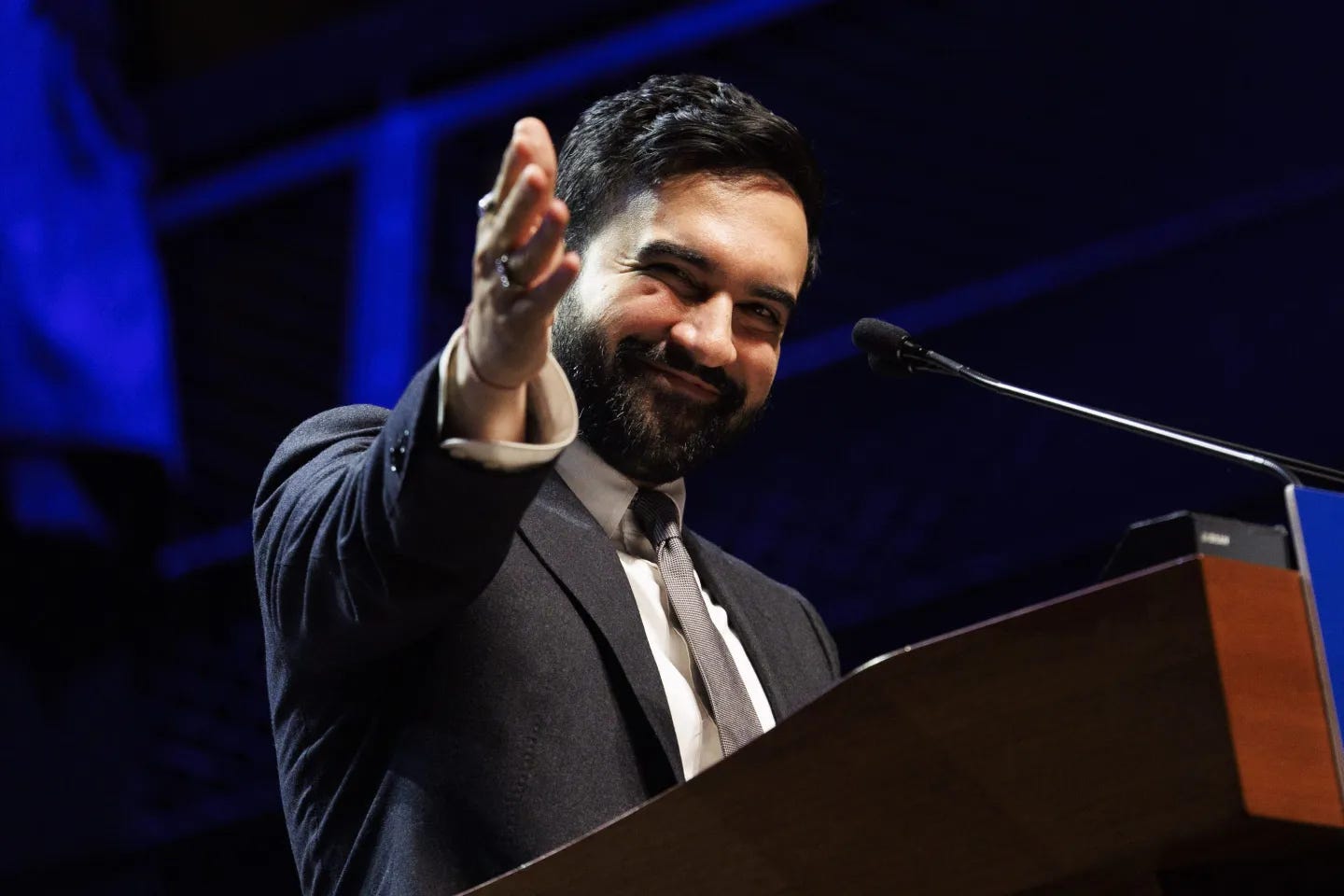
Zohran Mamdani is the de facto leader of the Democratic Party.
The proof arrived in increments, the way it usually does, but by the early hours of June 24th there was no honest way left to read New York’s congressional primary results except as confirmation of something that had already been true and was only waiting for a Tuesday to prove it.
Five days earlier, at a rally inside Brooklyn’s King’s Theater, Mamdani had stood beside Bernie Sanders and three of his endorsed congressional candidates and gone after the American Israel Public Affairs Committee by name. Borrowing a line from the Italian Marxist Antonio Gramsci about a dying world giving birth to monsters, he described the forces arrayed against his slate as monsters that took many forms, and named AIPAC as one of them: an organization, in his telling, more afraid of an end to the war in Gaza than of democracy itself, willing to “move millions in dark money” to keep its own power intact. The backlash arrived within the day. New Jersey congressman Josh Gottheimer wrote that swapping “AIPAC” for “Jews” would make it “the oldest antisemitic conspiracy theory in the books.” Ted Deutch, head of the American Jewish Committee, said calling people monsters was not debating ideas, it was “dehumanizing the people you disagree with.” Rabbis across Manhattan called it incitement.
Mamdani did not flinch. Four days later, with the controversy still running on every front page in the city and early voting numbers low enough to worry his own campaign, he stood at a City Hall press conference and defended every word of it. AIPAC’s posture, he said, was a status quo for immorality that he would not accept, and when death and destruction happens overseas, he added, it is worth pausing to “name those who allow it to take place.” It sounded, in the moment, like the kind of fight a candidate picks right before he loses. By the time the votes were counted on Tuesday, it had stopped sounding like a gamble and started sounding like a forecast. Brad Lander beat ten-year incumbent Dan Goldman in the Tenth District by nearly two to one. Claire Valdez took the open Seventh District over Brooklyn Borough President Antonio Reynoso, the chosen heir of a retiring congresswoman and most of the borough’s old guard. And in the Thirteenth District, a thirty-two-year-old community organizer named Darializa Avila Chevalier did the one thing nobody in the city’s political establishment had priced in: she beat Adriano Espaillat, the first Dominican American ever elected to Congress and the sitting chair of the Congressional Hispanic Caucus, in the night’s closest and most symbolically violent result.
Mamdani went three for three against a slate carrying the endorsements of Hakeem Jeffries and Kathy Hochul, the two officials most responsible for the machine that still calls itself the New York Democratic Party. Six months into a mayoralty whose approval rating has not yet cracked fifty percent, he turned one primary night into the clearest evidence yet that the city’s establishment cannot beat him where it counts, which is at the ballot box. The National Republican Congressional Committee called it the night the party “officially surrendered” to its socialist wing. Van Jones, watching the returns on CNN, said the roof was collapsing on the establishment in real time, which is the sort of thing people say on television the night something happens to actually be true.
None of this occurred because Sanders and Barack Obama looked at the polling and decided the wrong Democrats were winning. The record says the opposite, and the gap between what happened and what it has since been made to sound like is the only story here worth telling in full.
Start with why the timing matters. NBC polling this year found that sixty percent of Democratic voters now hold negative views of Israel, a reversal from the sympathy the party’s base expressed as recently as 2023, and independents have drifted the same direction, with half of them negative as well. Congress has not caught up with the people it represents, and that gap, more than any single man’s ambition, is what Tuesday actually measured. An establishment that can no longer win this argument in public, and just spent millions losing it three times over, is left with two options: keep losing primaries the way Jeffries and Jacobs did, or find a way to make the man making the argument feel like one of their own before he has any reason left to need them.
Sanders has been Mamdani’s most reliable validator in Washington since the 2025 mayoral primary, when he called it “absurd” that party leaders would not endorse their own nominee. He did not soften that position for the midterms. He spent the week before Tuesday’s vote campaigning in person for Lander, Valdez, and Chevalier, and there is no daylight anywhere in the record between what Sanders says about Mamdani and what Mamdani says about himself. Whatever is coming for this movement, it is not coming from Vermont.
It is coming, if it is coming from anywhere recognizable, from the names on the losing side of Tuesday’s tally. Jeffries endorsed both Goldman and Espaillat, an unusual position for a House Minority Leader to take against the mayor of his own home borough. Hochul backed Goldman outright, as did the city’s largest municipal labor council. New York’s state party chairman, Jay Jacobs, had drawn this line a year earlier, refusing to endorse Mamdani for mayor and naming his economic platform and his positions on Israel as the reasons. Kirsten Gillibrand told a New York radio audience, with no evidence behind it, that Mamdani had made references to “global jihad,” and later apologized. And on primary night itself, Attorney General Letitia James said Mamdani was “blowing up” the Democratic Party, a complaint that read less like analysis than like someone watching her own house catch fire and calling it arson.
Espaillat’s campaign did not limit itself to money. He accused Avila Chevalier of attending a pro-Palestinian rally held the day after Hamas’s October 7th, 2023 attack on Israel, an event in which militants killed 1,200 people and took more than 250 hostages, and charged that she had gone there to celebrate the deaths of innocent Israelis. She denied it at a debate earlier in the campaign. Whatever the charge was worth, it did not survive the count.
This is the establishment that actually fought Mamdani on Tuesday, with money, with endorsements, and with two sitting members of Congress on the ballot. It lost every contest it entered. In the Tenth District, it did not lose narrowly.
The mechanism behind that loss has a paper trail, and the paper trail runs through Israel.
Start with Espaillat, since his campaign received the most direct version of the help. United Democracy Project, the super PAC affiliated with the American Israel Public Affairs Committee, made two contributions in May totaling more than $600,000 to a vehicle called BOLD America, which went on to spend nearly $2.8 million opposing Avila Chevalier while propping up the incumbent it was meant to save. Espaillat’s own campaign had already taken $5,000 directly from AIPAC since 2025, plus another $140,000 in AIPAC-earmarked donations routed through individual donors, a channel that does not appear anywhere in the outside-spending totals voters were shown before they cast a ballot. Reporting from Drop Site News found a late surge of contributions to Espaillat from people who had previously given to AIPAC itself, arriving in the campaign’s final days, after most of the deadlines that would have let anyone see it coming.
Goldman tells a quieter version of the same story. He has been AIPAC’s preferred candidate in the Tenth District since his first race in 2022, he remained listed on the group’s own candidate page through primary night, and he collected more than $377,000 in direct and earmarked AIPAC money this cycle alone. He had also declined to endorse Mamdani in either the 2025 mayoral primary or the general election, citing concerns about the now-mayor’s record on antisemitism, a history Lander made a centerpiece of his campaign rather than a footnote to it. Across both races, the mechanism is one this publication has already documented in AIPAC’s national operation this year: a $96 million spending program, much of it routed through shell committees with names built to obscure who is actually paying for the ads. New York’s BOLD America is the same machinery wearing a different name in a different borough.
That loss is the exception, not the rule, which is exactly what makes it worth pausing on. The same campaign-finance reporting that tracked United Democracy Project’s spending this cycle counted ten other House primaries, from California’s Central Valley to the Rio Grande Valley, where pro-Israel-backed candidates won outright. New York’s three districts are the outlier, not the template. A national apparatus engineered to insulate incumbents from primary challenges on Israel ran into one mayor with a get-out-the-vote machine he had built for a single municipal race, and it lost three for three in the one place it met him face to face. That tells you something specific about Mamdani’s organizing capacity in New York. It does not yet tell you the model has stopped working anywhere else.
The “monsters” line that opened this piece was not a rhetorical flourish for a rally crowd. It was Mamdani naming, days before anyone outside the Federal Election Commission could see the filings, the precise mechanism sitting underneath it, and the death toll he cited in his own defense was not rhetorical either: Israeli strikes have killed more than a thousand people in Gaza since October’s fragile ceasefire, according to the Palestinian Ministry of Health. Whatever judgment a reader reaches about the word he chose, the spending record underneath it is not in dispute. The shell companies were real, and the districts where the money concentrated were the three districts where the establishment lost.
The Democrats who pose the real structural risk to Mamdani’s movement are not the ones who lost to him on Tuesday. They are the ones who have spent the past year making sure they never had to fight him at all.
Barack Obama got on the phone with Mamdani in the days after his 2025 mayoral primary win, congratulated him, and offered governing advice, according to people familiar with the call. David Axelrod, Obama’s longtime strategist, visited Mamdani’s campaign headquarters in person and came away comparing him to a younger version of his old boss, describing a “familiar spirit” of “determined, upbeat idealism.” Jon Favreau and Dan Pfeiffer, both Obama alumni, opened a direct line to Mamdani’s senior aide, Morris Katz. And in April, Obama appeared with Mamdani at a Bronx pre-K center to read a children’s book and lead a sing-along, a photo opportunity engineered, with some care, to project warmth rather than rivalry.
None of this is hostile, which is precisely what makes it the more durable of the two strategies on offer. A faction that endorses your opponent and loses, the way Jeffries and Jacobs did, has nothing left to negotiate with. A faction that calls to congratulate you, sends its most trusted strategist to praise your spirit, and starts routing its own former staff toward your inner circle has built itself a permanent seat at your table without winning a single primary against you.
Kamala Harris ran a cruder version of the same play in September of 2025, when asked directly on MSNBC whether she endorsed Mamdani for mayor. She said only that he was the Democratic nominee and should be supported, then turned to a list of other Democrats running for office in cities across the country and added that Mamdani is “not the only star.” It was party-unity language with the substance removed. Where Jacobs offered open opposition and Jeffries offered prolonged silence, Harris offered something closer to demotion through inclusion: acknowledge the win, then widen the frame until it no longer means anything in particular.
The comparison reaching for this moment, including from the pollster Adam Carlson in Newsweek’s coverage of Tuesday’s results, is the Tea Party’s takeover of the Republican coalition after Obama’s own win in 2008. It is the right comparison. It is also missing the half of that history that should worry the people doing the absorbing more than it worries the people being absorbed.
The Republican establishment did not stop the Tea Party in 2010. It did roughly what Obama’s circle is doing now: it absorbed the energy, handed incoming members committee seats, folded the movement’s language into the party’s own, and assumed incorporation would dilute the threat the same way Harris’s “not the only star” line is built to dilute Mamdani’s. It did not work. The members it absorbed organized into the Freedom Caucus, built an independent power base inside the institution that had tried to digest them, and in 2015 forced Speaker John Boehner into early retirement rather than accept his leadership. Absorption bought the Republican establishment five years. It did not buy permanent control, and the bill came due in a form nobody who designed the absorption strategy had budgeted for.
Mamdani’s position differs from the Tea Party’s freshmen in one structural way that matters: he is not entering Congress as a backbencher waiting on seniority. He is a sitting mayor with a national following, a primary win rate of three for three against the New York machine, and a circle of allies, Sanders chief among them, who never needed absorbing because they were never adversaries in the first place. The mechanism Obama’s orbit is running on him assumes the same outcome the Republican establishment assumed in 2010, that proximity and praise eventually convert into control. The Tea Party’s own history says that assumption has a shelf life. Mamdani has already shown which side of that history he intends to be on.
Mamdani’s advantage right now is that his loudest enemies keep losing where everyone can see it. Three congressional seats in a single night is not an abstraction. It is Jeffries’ home turf, Hochul’s nominal party, and Jacobs’ own state committee handed a result none of them can spin into anything but defeat, backed by a documented AIPAC spending architecture that lost in every district it tried to defend. Every public confrontation Mamdani wins sharpens his claim to be the party’s actual kingmaker rather than its problem child, and Republicans understand that math well enough to be running ads built entirely around it.
The harder question is what happens once the fight stops looking like a fight, and Mamdani has already started answering it. Obama read picture books with him in the Bronx in April. Two months later, Mamdani stood at King’s Theater and endorsed three more insurgents against the same establishment that had just tried to befriend him, then watched all three of them win. Asked directly by NBC’s Kristen Welker whether he wanted to see Kamala Harris run for president again, he ducked the question outright and called his own refusal to engage with it something he was “proud of.” Those are not the choices of a man drifting toward incorporation. They are the choices of a man who took the warmth on offer and kept fighting anyway.
The absorption strategy assumes proximity eventually converts into control. Mamdani has spent the better part of a year proving that assumption wrong, one primary at a time, while still taking the phone calls that were supposed to make him stop. The Democratic establishment is not chasing a kingmaker it can still capture. It is chasing one who has already said no.


